The Colin Boy’s Disappearance
And Their Children After ThemThe Colin Boy’s Disappearance is the unresolved disappearance of a young man after a lakeside melee on Bastille Day. The Colin boy was known to have attended the gathering, but he was missing by morning and his body was never found. The search produced no decisive answer; instead, witness reports, rumors, and a newspaper photograph became the fragments through which the town understood his absence.
Causes and Background
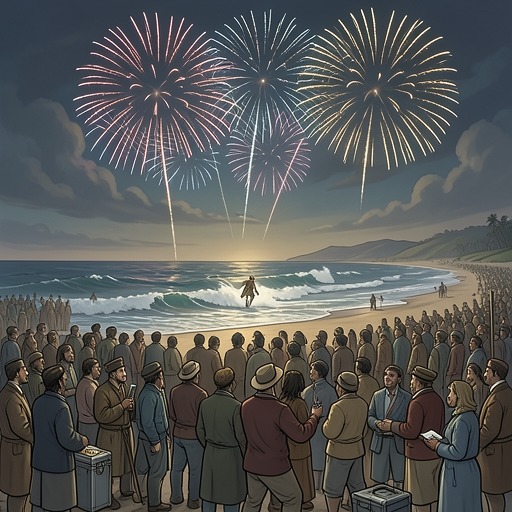
A year before the scene in which Anthony considers the event, people from the surrounding area had gathered at the lakeshore and in the woods to watch the Bastille Day fireworks. Campfires and barbecues were part of the gathering. A fight broke out shortly after midnight: men on leave from the barracks attacked Arab residents from the housing projects, and people from Hennicourt joined in. Other campers were drawn into the melee, including young people and some fathers. The crowd’s varied composition matters to the event: this was not described as a confrontation between only two groups, but as a gathering that widened into disorder.
The Colin boy had come with friends who had recently passed their baccalauréat and did not have driver’s licenses. Arnaud, Alexandre, and Sébastien later testified that they had gone to watch the fighting without planning to take part. They became caught up in the melee, after which the account of what happened grows uncertain. Their testimony establishes the Colin boy’s presence at the lakeshore, but does not explain how he disappeared.
The Search and Conflicting Accounts
In the days that followed, the préfet ordered a search of the neighboring woods, while divers searched the lake. Onlookers watched the firefighters’ orange Zodiac go out and return. The repeated searches offered the crowd a visible sequence of activity, but no discovery that could settle the question of the boy’s fate.
Witness accounts added to the uncertainty rather than resolving it. Several people said they had seen a boy who appeared to be hurt; reports also described blood on a shirt and an injury to the neck. In the confusion, nobody came forward to help him. The account does not establish whether the boy those witnesses described was the Colin boy, nor does it identify what happened after the fight. By morning, the Colin boy’s bed was empty. The gap between the reports and what could be confirmed became central to the disappearance: there was evidence of possible harm, but no verified account of the final events.
Family, Rumor, and Public Attention
As the search continued, stories circulated about the Colin boy’s mother. Some claimed that she was in hospital and sedated; others said she had hanged herself or had been seen wandering in her nightgown. The narrative distinguishes these rumors from what later proved to be the case: she had taken pills, but had not hanged herself. The conflicting accounts show how the family’s distress was discussed publicly even while the central mystery remained unanswered.
The Colin boy’s father was a town police officer and a hunter. He stayed aboard the firefighters’ boat during the search, bareheaded in the sun, while people watched from shore. The onlookers found his stillness and apparent calm unsettling; they expected him to act, or at least to move. Their reaction records the pressure placed on him by the crowd, but it does not establish what he felt or what he knew. His return to work without making a public fuss likewise supplies no explanation for the disappearance.
A newspaper photograph gave the absent boy a more definite public image. It showed him in a red T-shirt, with curly hair and brown eyes, and the accompanying article reported that he had passed the baccalauréat with top honors. The article’s emphasis on his academic achievement sharpened the contrast between a promising young man and an unexplained disappearance. Patrick Casati’s comment on the report links the image to the adult community’s judgments about the boy and his family, without solving what happened at the lakeshore.
Unresolved Outcome and Narrative Significance
The boy’s body was never found. The woods and lake were searched, but the account leaves the cause and exact circumstances of his disappearance undetermined. His father went back to work, and the rumors about his mother did not supply a resolution. The event therefore ends not with a confirmed death or an identified perpetrator, but with absence and an incomplete public record.
The episode is recalled while Anthony is at the water a year later, refusing his cousin’s suggestion that he swim. That placement brings the past disappearance into a present scene of idleness by the same lake. The crowded night of fireworks and fighting is set against Anthony alone with the water, and the remembered event makes the landscape carry a history that ordinary summer leisure cannot erase. Its unresolved details also establish a contrast between what the town believes and what it can know: the crowd assigns blame and expects a dramatic response, while the search yields no body and the witnesses cannot provide a complete account.